
Main Roads WA has released a NEW Code of Practice for Works on Roads in March 2025. We’ve put together a helpful article that summarises some of the key changes from this update.
If you and your organisation work on or near roads, then this is a must-read for you.
It is important to note that this article is not a full definitive summary of all changes and is only a summary of key changes. Please ensure you and your team have downloaded the latest version, all amendments and revisions can be found at the beginning of the document.
The following is a summary of the key changes:
2.1 Section 4.2.1 General (Traffic Management Plans)
New requirement to include a dated photo to evidence a site visit was undertaken for site specific TMPs:
TMPs must be signed by the person that prepared them, along with their name, AWTM certificate number and the date of endorsement of the plan. In addition, the person preparing a TMP must also include a statement on the plan confirming that a site visit was undertaken by them or another person under their direction, prior to preparing the plan along with a dated photo from the site visit (not required for Generic TMPs, see 4.2.2).
2.2 Section 4.2.2 – Generic TMPs
Clarity on undertaking the Generic/Site Specific TMP checklist and TGS procedure.
2.3 Section 4.6 – Vulnerable Road Users
New requirements to ensure path users are given a higher priority. Primary Path Closures in the Metropolitan Area.
Any planned works in the Perth Metropolitan area that require a closure of an existing path designated by the Department of Transport as a Primary Route* for a period of 7 days or more:
• must obtain approval from the Main Roads Planned Interventions (RPI) section, ensuring they are satisfied with the proposed detours. RPI will require a minimum of 15 working days’ notice to review the TMP and associated TGS.
• must be a Traffic Guidance Scheme indicating the path detour and the proposed signs have been endorsed by a person that holds RTM accreditation. The RTM must have undertaken a site visit of the proposed detour (visiting the entire proposed route).
• A compliance safety inspection (refer to section 5.1.2) of all Primary Path Route detours must be conducted by a person that holds AWTM accreditation within 24 hours of implementation (this must be taken from the perspective of a path user). This must be submitted to Main Roads Planned Interventions (RPI) section via enquiries@mainroads.wa.gov.au
2.4 Section 6.1 – Temporary Signage
2.5 Section 6.1.8 – ROAD CLOSED and FOOTPATH CLOSED signs
2.6 New section – Section 6.1.12 – Detour Signs
Signing for detours must be in accordance with AS1742.3 and AGTTM. However, the below wording from section 3.7 of AGTTM Part 3 does not apply in WA:
The first detour marker must be placed no more than 100 m past the DETOUR AHEAD sign (or VMS). Detour markers are mounted horizontally with the arrow either vertically upward, at 45 degrees upwards to the left or right, or horizontally to the left or right.
2.7 Section 6.2.4 – Selection and Use of Multi-Message Signs
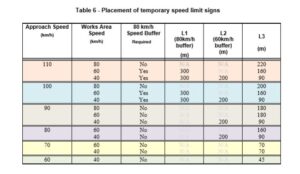
2.8 Section 6.5.2 – Setting out Temporary Speed Limit Signs
Clarity added for applying table 6 and/or AGTTM for placing speed limit signs:
2.9 New section – section 6.5.4 – Length of Temporary Speed Zones
The eighth (8th) dot point of section 5.5.1 of AGTTM Part 3 states ‘The length of the temporary speed zone should be as shown in Table 5.5’. In WA this must be replaced with:
The length of the temporary speed zone must be as shown in Table 5.5
2.10 Section 6.8.2 – Avoiding End of Queue Collisions
Updates to figures 4 and 5 to include option to use queued traffic signs (MMS-ADV-90 and MMSADV-91)
2.11 Section 6.8.3 – Portable Traffic Control Devices
Updated to expand the use of PTCDs on all State roads
2.12 Section 6.8.4 – Traffic Controllers
2.13 New sub-section – 6.8.6 – Portable Boom Barriers
Guidance from Portable Temporary Boom Barrier Guideline incorporated.
2.14 Section 6.8.7 – Roadworks Pilot Vehicles
2.15 Section 6.17 – Approach Tapers
New subsection to clarify taper requirements.
2.16 Section 8 – Accreditation Requirements
New accreditation for people in Main Roads and LGAs to undertake the Advance Worksite Traffic Management course written assessments and come away with the AWTM – Non-Practitioner accreditation:
What Do I Need To Do?
As a result of the above changes, here are some recommended actions or steps to take;
- Make sure you are a subscriber to our mailing list – that way you will receive this and any future updates direct to your mailbox. To sign up click here.
- Download and read the new Main Roads WA Code of Practice Works on Road online click here. Please note there are other changes not summarised in this article, therefore it is important you read the full updated document.
- Inform your organisation and co-workers about these new changes ahead.
- Review your workplace policies, procedures, and other documents that may be impacted. Schedule time to update workplace documents and convey these changes to your team.
Got Questions?
Do you have any questions or need further assistance with any part of the new Main Roads WA Code of Practice for Works on Roads? Get in touch and contact us.
Do you need training?
Do you need temporary traffic management training for your team? We have a wide range of public training courses view calendar here or our team can travel to your workplace for onsite training request a quote here.